


Embroidered Eyelets, Pleats and Layered Bag Surfaces | AUTRON W43

A bag can feel new because of its surface rather than its silhouette. AUTRON Techniques W43 explores five ways to add depth, movement and lightness while keeping the underlying bag construction straightforward.
Our starting points were Chloé Summer 2027, shown on 1 October 2026, and ISSEY MIYAKE Spring Summer 2027, shown on 2 October and documented in the brand’s 3 October release. Chloé explored embroidered openwork and transparent layering; ISSEY MIYAKE presented pleats, crinkled textures and marbling on sheer cloth. These are observed runway signals. The bag applications below are our own development proposals, not reproductions of either collection.
Each direction has three suggested material combinations. All images are labelled Concept render. Fibre composition, finish, durability, cost and production suitability remain subject to supplier confirmation and sampling. No social-media ranking, sales figure or viral claim is used.

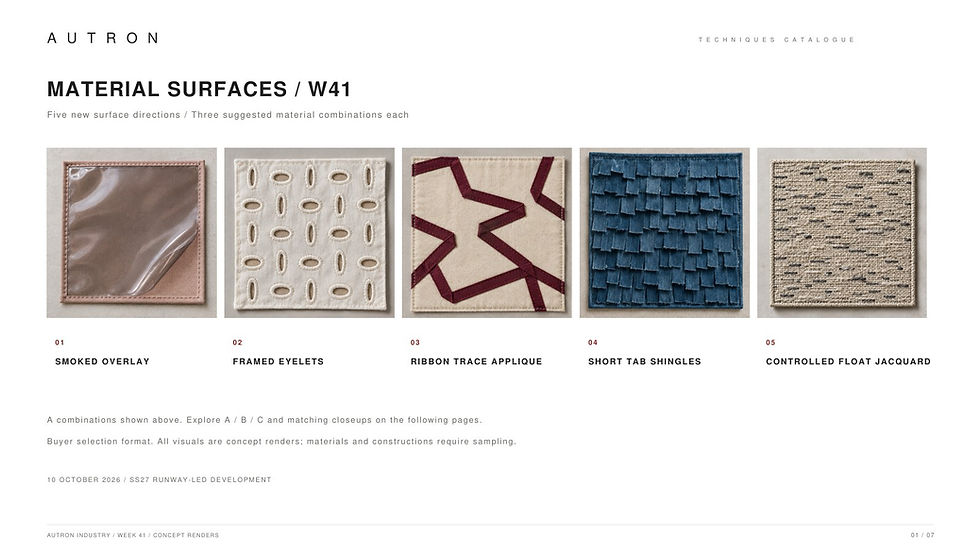
T01 / Embroidered eyelets
Stitched openings give a plain cloth surface quiet depth. Suggested applications: Lined summer totes, buckets and inset front panels.

A — Ivory cotton canvas / ecru embroidery / sand backing.
B — Washed-indigo denim / navy embroidery / pale-blue backing.
C — Black polyester organza / tonal embroidery / smoke satin.
Keep the load-bearing perimeter plain. The opening pattern should be assessed after embroidery and cutting, because the appearance of a flat swatch does not establish how the panel behaves in a filled bag. A separate lining lets the buyer choose between stronger contrast and a quieter tonal effect.
Sample checks: Trial embroidery before cutting openings. Check fray, hole distortion, thread rub and lining visibility under load.
T02 / Shadow applique
A translucent veil softens the outline of stitched shapes. Suggested applications: Occasion pouches, compact shoulders and feature pockets.

A — Milk polyester open net / sage cotton shapes / ivory canvas.
B — Smoke nylon mesh / charcoal PU shapes / grey nylon.
C — Blush polyester tulle / burgundy satin shapes / rose satin.
Treat the veil as a decorative layer. The bag body and handle attachments should be supported independently. Use a simplified, original shape arrangement so that the difference between materials remains visible; adding more motifs is unlikely to improve the comparison.
Sample checks: Trial veil snagging, shape-edge lift, stitch tension and colour transfer. Keep high-friction zones on a plain base.
T03 / Fine-set pleats
Narrow folds build movement into a restrained panel. Suggested applications: Soft shoulder bodies, drawstring pouches and gusset inserts.

A — Stone polyester twill / taupe woven anchoring tape.
B — Blue-grey polyester organza / navy satin backing.
C — Aubergine polyester satin / tonal grosgrain anchoring tape.
Agree the finished panel width after pleating rather than cutting the bag from an untreated fabric width. The concept is a narrow folded surface with a stable border. It does not assume that every cloth can accept or retain the same heat-setting process.
Sample checks: Confirm heat-setting suitability with the fabric supplier. Trial crease recovery, seam bulk and loaded shape before grading.
T04 / Controlled shirring
Gathered stitch rows create texture without added padding. Suggested applications: Soft hobos, compact shoulder bags and pouch fronts.

A — Ivory cotton poplin / ecru woven stay backing.
B — Moss nylon ripstop / dark-olive woven stay backing.
C — Cocoa viscose satin / brown woven stay backing.
Use a stable stay layer to control the panel outline while leaving the surface gathered. A trial should compare the empty bag with a representative filled bag. The selected construction needs to carry the load without pulling the gathered rows flat.
Sample checks: Trial gathering ratio and anchoring. Check finished panel dimensions, seam slippage and shape recovery after handling.
T05 / Abstract waterprint
A fluid print adds movement while the cloth stays simple. Suggested applications: Everyday totes, fold-over pouches and scarf-like bag panels.

A — Sand cotton canvas / tobacco-charcoal pigment-print trial.
B — Smoke-blue polyester organza / navy-ice dye-print trial.
C — Plum polyester satin / muted copper-blush dye-print trial.
The rendered appearance is a print direction, not evidence of a metallic finish or a particular printing process. A buyer can compare the same quiet movement across a matte canvas, a translucent layer and a satin face. Approve a physical strike-off before reviewing a full bag.
Sample checks: Select the print process for the substrate. Trial dry/wet rub, colour migration, repeat joins and seam placement.
Fittings should support the surface

Satin nickel, brushed brass and gunmetal are proposed finish directions. Attach fittings through solid tabs and an appropriate reinforcement, with the final finish and fastening checked on the complete bag. Delicate veils, eyelet openings and pleated areas should not be treated as tested load-bearing structures.
W43 special study: eight logo processes

A separate W43 CAD supplement compares blind deboss, foil transfer, satin-stitch embroidery, cut applique lettering, woven labels, screen printing, a moulded silicone badge and a metal wordmark. The choice should follow the substrate and the intended bag feel. Smooth coated surfaces, woven cloth and lightweight nylon require different trials; one logo process should not be assumed to work equally well on all three.
The study uses AUTRON as the sample wordmark, with proposed front artwork, schematic sections and reverse fixation. All sizes are suggestions. These drawings are development concepts, not tooling files or production approval. Before ordering a die, mould or metal sample, approve the exact artwork, substrate, reinforcement and test criteria.
From a selected direction to a sample
Start with one surface, one bag shape and the intended end use. Compare material swatches first, then approve a representative panel that includes the actual seam, lining and fitting. This makes the differences in drape, bulk and handling easier to judge before developing a complete bag.
Sources and research date
Research checked on 24 October 2026. Sources are references for material observations only and do not imply a commercial relationship with AUTRON.

Comments